Ever sinceStreet Fighterfirst started appearing in arcades back in the late 80s,Capcomhave been proclaimed by many to be the kings of the fighting game genre, and they’re still releasing new entries in this beloved genre to this day. Because they managed to nail the core-gameplay of their fighting games very early on, they’ve been able to implement numerous interesting mechanics, systems, and modes over the years to build upon each game that came before.
While not all of these attempts were successful (Final Fight Revenge, anyone?), most of Capcom’s fighting games have been very well received by both critics and hardcore fans of the genre. But which ones are the best of the bunch? Here’s a breakdown of some of the best fighting games Capcom has ever released, and why they became so beloved by fans of the genre.

Updated July 06, 2025, by David Heath:Since the last update toStreet Fighter 5, Capcom has fallen back in love with its fighting games. TheCapcom Fighting Collectionbrought theDarkstalkersseries back from the dead.Street Fighter 6has become one of the most successful fighting games ever made. Fans got hyped by theMarvel Vs Capcom Fighting Collectionbringing back the classic crossover series, and theCapcom Fighting Collection 2will bring back another viaCapcom Vs SNK 1 & 2. It’s a good time to be a fighting game fan, and a better time to be a fan of Capcom’s fighting games. This list has been updated with a few more choice selections, from some games awaiting their re-release, to ones that might not get so lucky. Though ifMarvel Vs CapcomandCapcom Vs SNKcan come back, anything’s possible.
12Jojo’s Bizarre Adventure: Heritage for the Future
Steamrolling the Competition
The series may be a mainstay among anime fans today, but for years, the only way audiences outside of Japan and a few lucky European nations knew this anime was throughJojo’s Bizarre Adventure: Heritage for the Future. Based onPart 3: Stardust Crusaders, players pick anyone from Jotaro to Dio and use their Stand abilities to overcome their opponents. Some are better used for rushdown strikes, others prefer to keep the opponent away, while others bring them up-close for punishment.
ThoughJojois a familiar series now, it’s a strange game to get into. Alessi’s Stand Seth transforms his opponents into kids or other vulnerable forms. Two characters, Iggy and Pet Shop, are hard-to-hit animals. Then, most famous of all, Dio can stop time for 9 seconds (1 second for each level of super meter) and drop a steamroller on his foe before pummeling it into them. Though it was only a cult success, and its balance is out of whack, it’s still the benchmark forJojofighting games.All-Star Battle RandEyes of Heavencouldn’t match its mechanics.
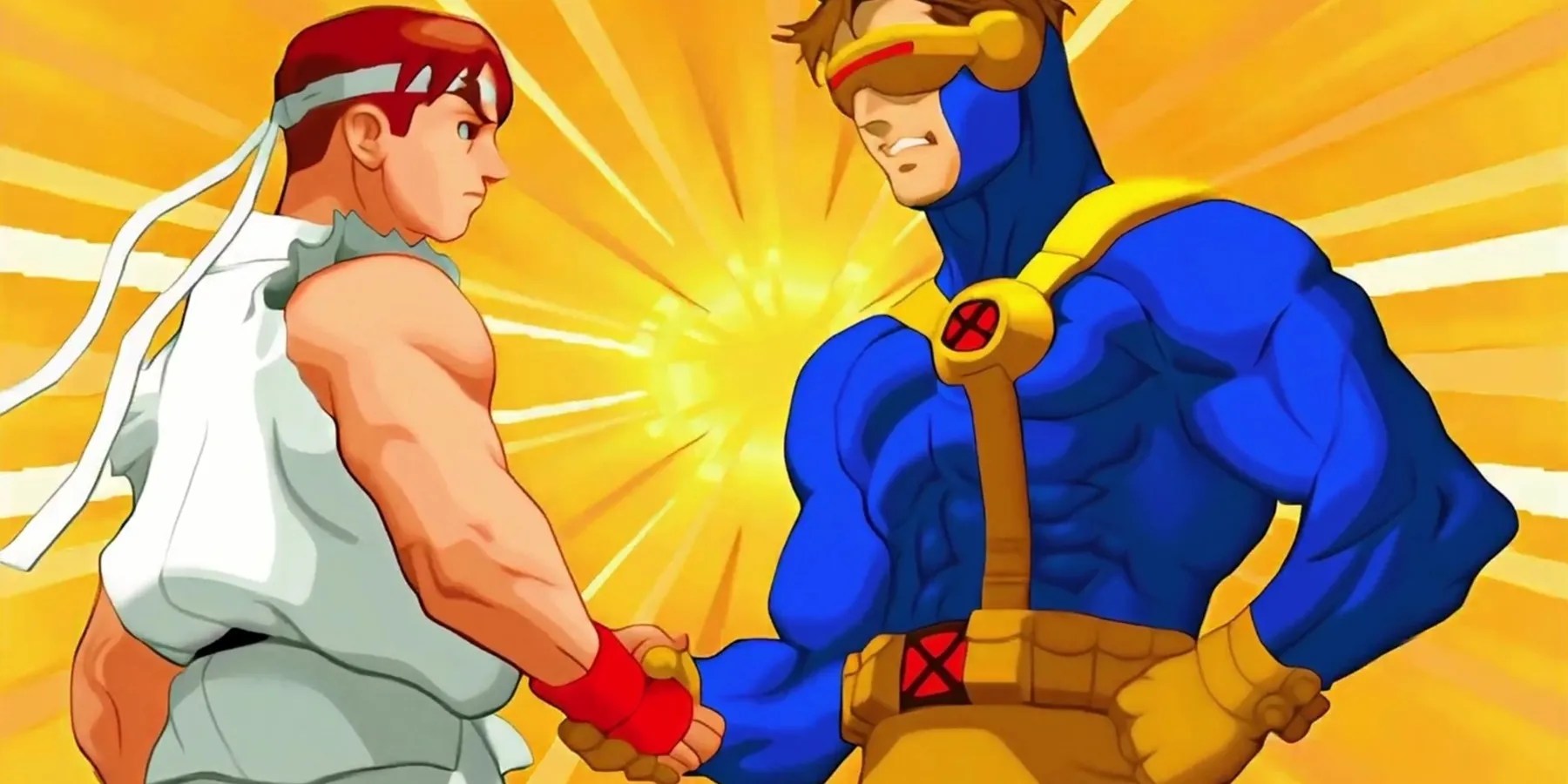
First, there wasX-Men: Children of the Atom, where the X-Men and their foes fought it out in aStreet Fighter 2-style game. It was fun, and even got cheeky by hidingSuper Street Fighter 2 Turbo’s Akuma in the roster. ThenMarvel Super Heroesdid the same with the broader Marvel cast, letting Spider-Man, Captain America and the Hulk in on the action. Then Capcom thought they’d dial things back to the X-Men, only to pit them off against the Street Fighters in tag-team action.
Thus,X-Men Vs Street Fighterwas born, where players could mix between the Mutants and World Warriors to make their ideal team. They could tag out between the two for fast, hard-hitting combos, or bring them in for an assist attack to drive their opponent off. The super combos were larger and more intense than theSFseries was doing at the time, and its bold, chunky graphics brought the comic characters to life. It was a sign of bigger things to come, as it laid the foundations for theMarvel Vs Capcomseries.

On the surface,Capcom VS SNKmay seem like an inferior version of its sequel since it’s more stripped back in terms of central mechanics (only 2 grooves), but it has its own charms. It still retains that high skill ceiling viathe Ratio system, which essentially refers to a character’s overall strength. As players create a team, they will only be able to reach a maximum Ratio of 4, meaning they could pick a single strong fighter, or make a team of 2-4 weaker characters to get the number advantage.
It’s a pretty simple system to adjust to, but unlike the sequel, the roster’s Ratio values are fixed. Sakura is always R1, Orochi Iori is always R4, etc. This makes picking the perfect team of fighters much more of a challenge, as players have to consider their strength as well as their skill. The game also features some visually stunning stages, many of which are far more detailed than other fighters at the time. They even outdo the sequel’s 3D efforts with its background characters, lighting effects, and ornate design.

Despite the efforts of fans and former producer Yoshinori Ono, Capcom isn’t in a hurry to return toDarkstalkersany time soon. The likes of Morrigan and Dmitri have spent more time making guest appearances in other games than in their home series. But in its prime, the series was a pretty formidable contender in the fighting game scene. With itsgothic aestheticand demonic cast of playable characters,Darkstalkerswas a break from the norm. It’s tricky picking up a single entry in the series, as they each have their own charms.
If only there was a game that combined everyDarkstalkersgame. Which is whereDarkstalkers Chronicle: The Chaos Towercomes in. It’s essentiallyevery character fromDarkstalkerstoVampire Savior, while allowing players to pick which version of them they want to play. They could pitDS1Victor with his AOE attacks againstDS2Donovan and his traps. The only problem is that it’s exclusive to the PSP, making it harder to track down than theDarkstalkers' separate entries in theCapcom Fighting Collection.

Many of the games on this list are going to involveMarvel,Street Fighter, and Capcom’s rivals SNK in some way or another, if only through sheer numbers. That doesn’t mean that other original games aren’t worth a look.Darkstalkersis a grand time, andPower Stoneis an underrated 3DSmash-style game. However, one of their most underrated games isRival Schools, where different students and faculty fight to save their schools from a hidden menace.
The brainchild of then-Street Fighter Alphaproducer and futureDevil May Crydirector Hideaki Itsuno, it was a team fighter where players couldn’t tag out, but could use their partner to provide different assist attacks. They could double the damage with Team Attacks, or give them a health/meter boost to keep them in the game for longer. Sadly, and curiously, it’s not part of theCapcom Fighting Collection 2, but its equally rare sequel,Project Justice,is. The latter gives the player two assists to work with, and a different mix of duo and triple team attacks.

With the death of arcades and the rise of home consoles, it looked like Capcom would leave fighting games behind, as only 3D efforts likeTekkenandSoulCaliburcaught on. That is, until Yoshinori Ono drove the company to produceStreet Fighter 4in 2008. With a flashy new visual style, a large cast of characters, and a plethora of new moves and techniques for players to utilize in battle,Street Fighter 4had everything it needed to revive interest in the fighting game genre all over again for a brand-new audience.
Thecore 2D fighting gameplayhadn’t been changed too much from its predecessors, but it introduced new universal moves like the Focus Attack, a move that could also stun the opponent if it landed, leaving them wide open for a combo, but took a while to charge up. Across its different updates, fromSupertoUltra, it brought in some of the series' most beloved new characters, like Juri Han, a sadistic taekwondo practitioner who’s merciless fighting style really helped her stand out from the rest of the cast.

When the originalMarvel VS Capcom 3was released in early 2011, its high-octane action and colorful visual aesthetic received a lot of praise from fans, but it did have a few balancing issues with a handful of characters being outright broken. This was going to be rectified over its different updates and DLC. Instead, thanks to the Tohoku earthquake, these plans became the standalone gameUltimate Marvel Vs Capcom 3, which brought in several fan-favorites, like Rocket Raccoon andVergil fromDevil May Cry.
It’s one of the most satisfying games to get good at, as its controls are simple to pick up, and the action is incredibly fast-paced, with characters flying across the screen to initiate devastating combos that go on for days. However, it also has an extremely high skill ceiling, especially when trying to combine the abilities of all three team members. The strongest characters, even busted ones like Phoenix and Zero, can take plenty of practice to get good with. Nonetheless, if players stick with it, they’ll find it an excellent title with plenty of content to get stuck into.

Fighting game rosters have gotten bigger over the years, butMarvel Vs Capcom 2is still one of the largest with 56 playable fighters, all of whom come from every otherMarvelgame Capcom had made to that point, with a few newbies like Cable and Tron Bonne. It needed to be this big as it was now a trio-on-trio bout instead of tag teams. Players could switch between their 3 characters, and pick different assists to allow their partner to jump in and perform a quick move to help out the main fighter during an intense bout.
This could open the opponent up for a midair combo or Hyper Combo (the game’s version of a Super Move), or open themselves up to get both their point and assist characters punished if they’re not careful. It’s these new levels of strategy that helped it catch on, despite its lack of polish and balance. Few other games took up its style, with justDragon Ball FighterZandGuilty Gear Strive’s upcoming 3-on-3 mode giving it a try. So, it’s no wonder whyMvC2is so beloved, with many looking forward to playing it again in theMarvel Vs Capcom Fighting Collection.

TheStreet Fighter Alphagames gave fans their long-awaited follow-up toStreet Fighter 2, albeit as prequels. Fans would have to wait longer forStreet Fighter 3, and once they were made, they actually faltered next to theAlphasequels. They were faster, had bigger combos, and larger rosters, especially withStreet Fighter Alpha 3. Some people prefer the purer looks and nicer music ofAlpha 2, thoughAlpha 3would go on to become the biggest and most popular entry in the series.
It had nearly every character in the series fromSF2onward, and introduced fan favorites like Cody, Rainbow Mika, and Karin. Its ISM system acted like a precursor toCapcom Vs SNK’s Groove system, offering three different ways to play, and even more if they tinker with its different modes. It’s been released on multiple systems in multiple forms, with its updatedUpperedition being included inCapcom Fighting Collection 2.No matter the platform, fans have plenty of time forAlpha 3.

Capcom Vs SNK 2grants players a staggering amount of freedom to take on their battles in any way they want, and because of this, itmakes the game incredibly replayableand a ton of fun to jump into, even if just for a few quick matches. Players are able to choose up to three characters to bring onto their team, but this isn’t always a smart idea as they have to match their strength to a Ratio. Single players reach a max strength of 4, while teams get divided between 1-3.
This already adds an extra layer of strategy to the game, as weaker teams get multiple shots to take on a single opponent, but that single opponent only needs to be beaten once. It also offers multiple different fighting styles, or “Grooves”, based on different Capcom and SNK fighting games. They encourage players to experiment with the gameplay until they fully master all the tools they can utilize in battle. Pair this with a massive roster, and it results in a great game that’s become the most anticipated entry in the upcomingCapcom Fighting Collection 2.
